Serendipity
How the pieces come together

I often give genealogy talks, teaching the methods I use to piece together family narratives. And there are some tried and true ones, most of them gleaned from my long career as a reporter.
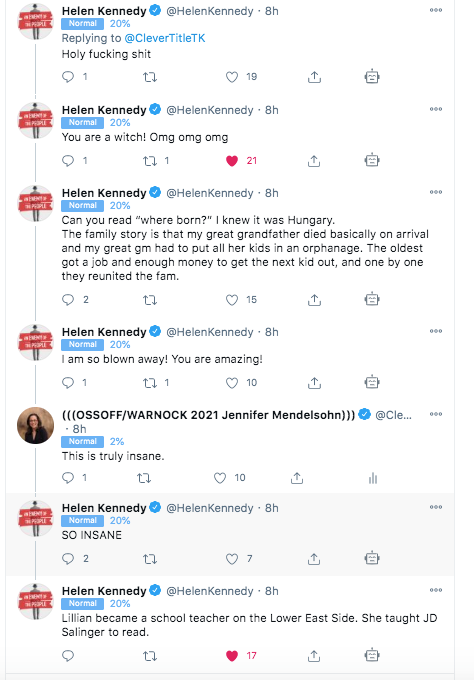
But there’s also an undeniable undercurrent of serendipity that runs through the genealogical world. In one of my favorite examples, I posted a photo on Twitter showing how research on my mother’s side of the family accidentally led me to the very page of the 1905 New York state census that showed my then-seven-year-old paternal great-aunt Lena Mendelsohn living in the Hebrew Orphan Asylum in New York City. A fortuitous coincidence.
But in an almost unbelievable twist, writer Helen Kennedy saw that tweet and recognized the names of her grandmother and great-aunt on the census, listed directly under Lena’s. She’d always known they’d been in an orphanage in New York City as children but never knew anything beyond that. A little further digging confirmed it was indeed them. What are the chances?
Not quite three weeks ago, I wrote about Holocaust Remembrance Day and shared the list of all my relatives who were lost in the Holocaust, a list that sadly still grows every year. You’ll notice that one of those entries was vague:

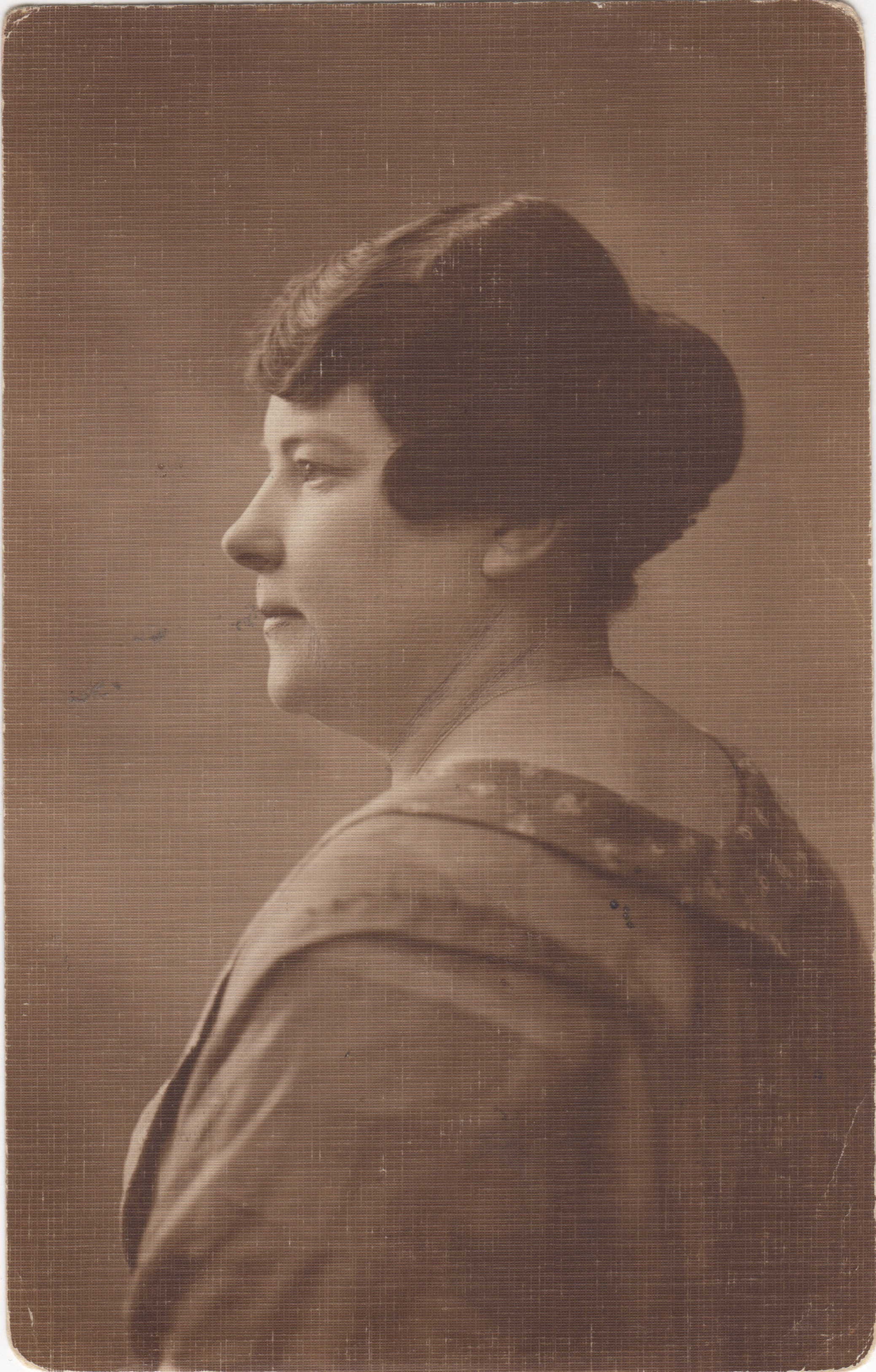
That’s because I had no idea what the married name of Chava Mendelsohn — my Latvian-born grandfather’s first cousin— was. I didn’t even know Chava Mendelsohn existed until a few years ago; we actually didn’t know the names of a single relative of my grandfather, dead or alive. But preliminary research connected me with Chava’s elderly niece in Cleveland, who sent me a batch of old letters and photos. She thought they were connected to her father’s two sisters who had perished in the Holocaust, but that was as much as she knew. With the help of the Latvian archives, I was slowly able to piece it all together: there were actually four Mendelsohn sisters, named Chava, Chana, Bluma and Reide, none of whom survived the war. And while I was easily able to find information about the other three, the only clues for Chava were a few photos, including this one of her husband with their two children.
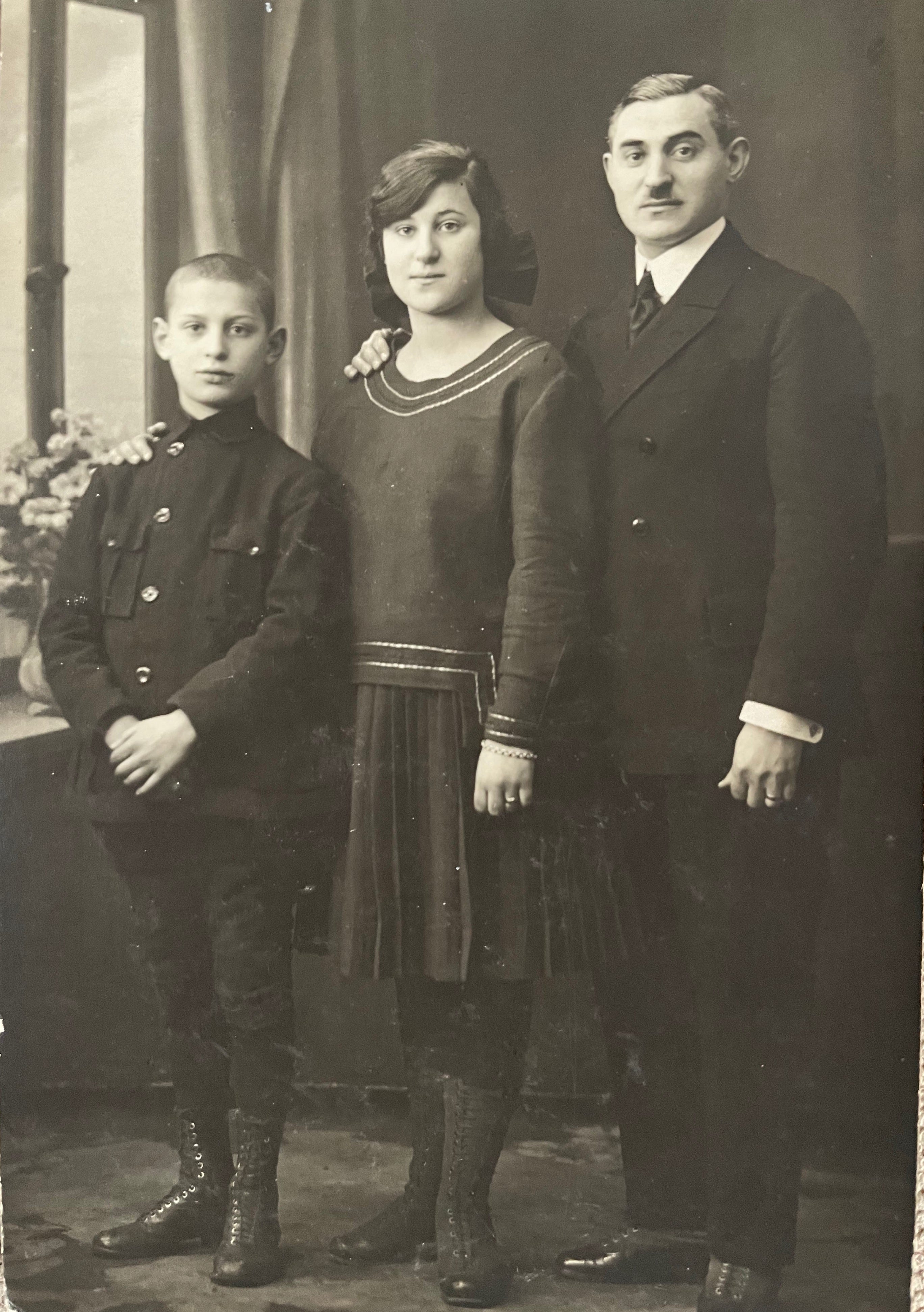
The back was inscribed in German. “Lodz 18 Oct. As an affectionate remembrance I send you this picture, of Jacob, Salcia and Max, taken this year.”
Finding out Chava’s married name was on my miles-long to do list. But — here comes the serendipity part — a Facebook post the other day alerted me to the fact that thousands of new files had been added to JewishGen’s Latvia database, specifically the internal passport files from a number of major Latvian cities. This was the same database I’d used, in part, to find out more about Chava’s sisters. The post reminded me of Chava, which might not have happened had I not just mentioned her on Holocaust Remembrance Day. I decided to see if I could unravel the mystery. Within just a few minutes, I had unearthed a wealth of information about Chava and her family, including her married name. And within a few hours, I could sketch the outlines of her entire sad story.
My first stop was the Yad Vashem Central Database of Shoah Victims’ names to see if I could find Chava, Jacob, Salcia and Max using only what I knew about them: their first names, their approximate ages, and that Chava had been born in Latvia. After a few unsuccessful searches, I got a hit that looked promising: I ran a search for anyone with a name that sounded like Chava born within a few years of Chava Mendelsohn, and from Latvia. That yielded just 27 people. And as I scanned the list, one of them, Chava Garelik, caught my eye because it said she lived in Lodz, Poland, the town listed on the back of the photo.
This testimony, by a woman named Lea Filitzer, said that Chava Garelik of Lodz was born in Riga, Latvia in 1880 and had a husband named Jacob, just as Chava Mendelsohn did. (One important footnote: the English transcription says only that Lea is a “relative,” but an Israeli friend was able to tell me that the Hebrew is far more descriptive, identifying Lea specifically as the sister of Chava’s son-in-law.) And I noticed that this same woman had also posted a testimony for a relative named Max Garelik, born in 1913, the son of a Jacob. Hmmm. Could this be my family? But what about Salcia? Lea had also provided a testimony for her sister-in-law “Ela Sarah Kac,” nee Garelik, daughter of Jacob, spouse of Aron. Hmmm.
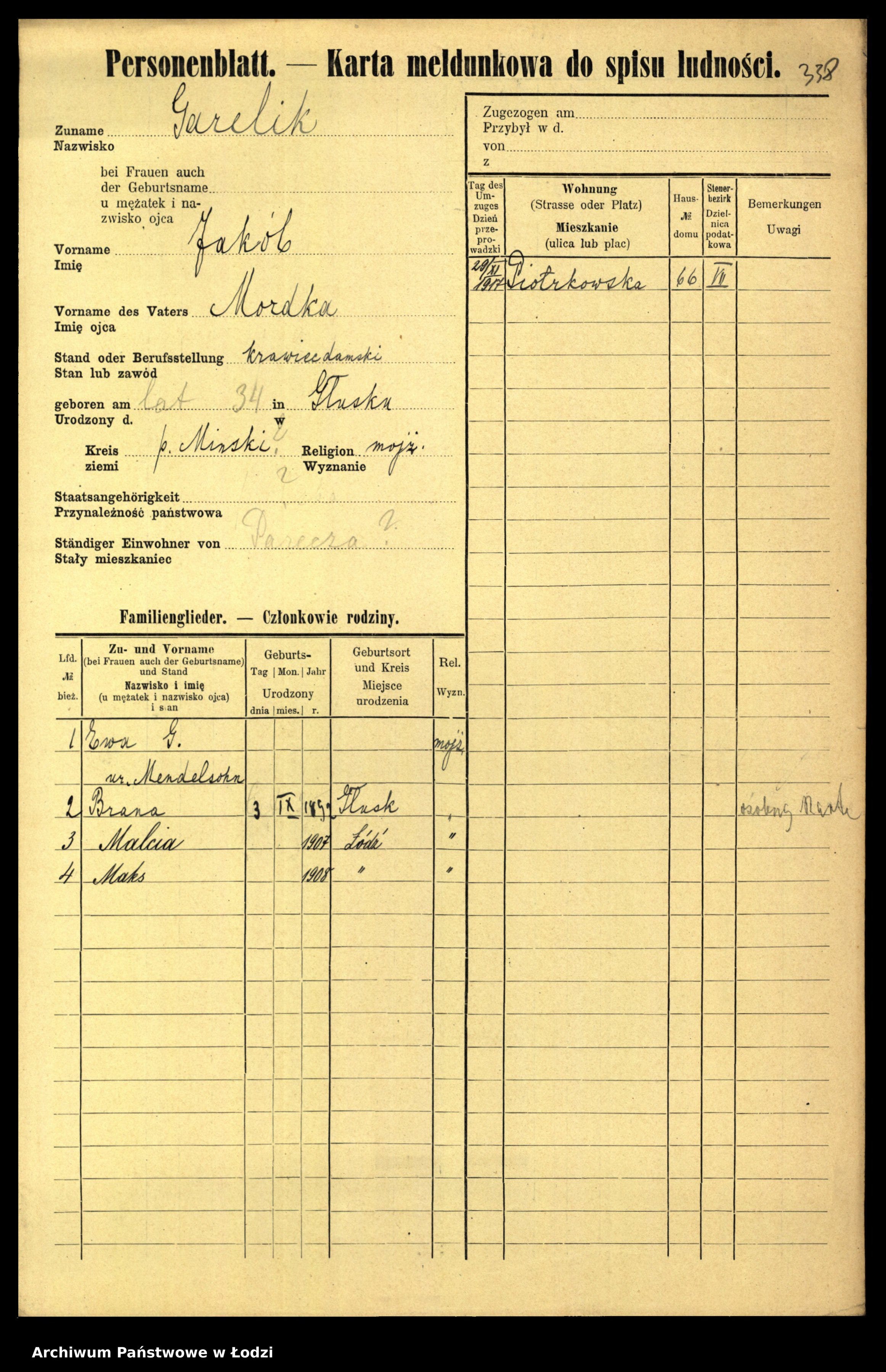
JRI-Poland.org provided the next clue. By searching for this Garelik family in Lodz, I found this registration card showing a family constellation that perfectly matched the one I was looking for, although daughter Salcia is misspelled as Malcia. And this document clearly said Chava (also known as Ewa)’s maiden name was MENDELSOHN. Bingo.
I have jokingly used the phrase “Law and Order Genealogy” to describe the way I work. You follow the clues the same way they follow the “dun duns” on the show. Tug hard enough and a whole thread will unravel; a story unspools.
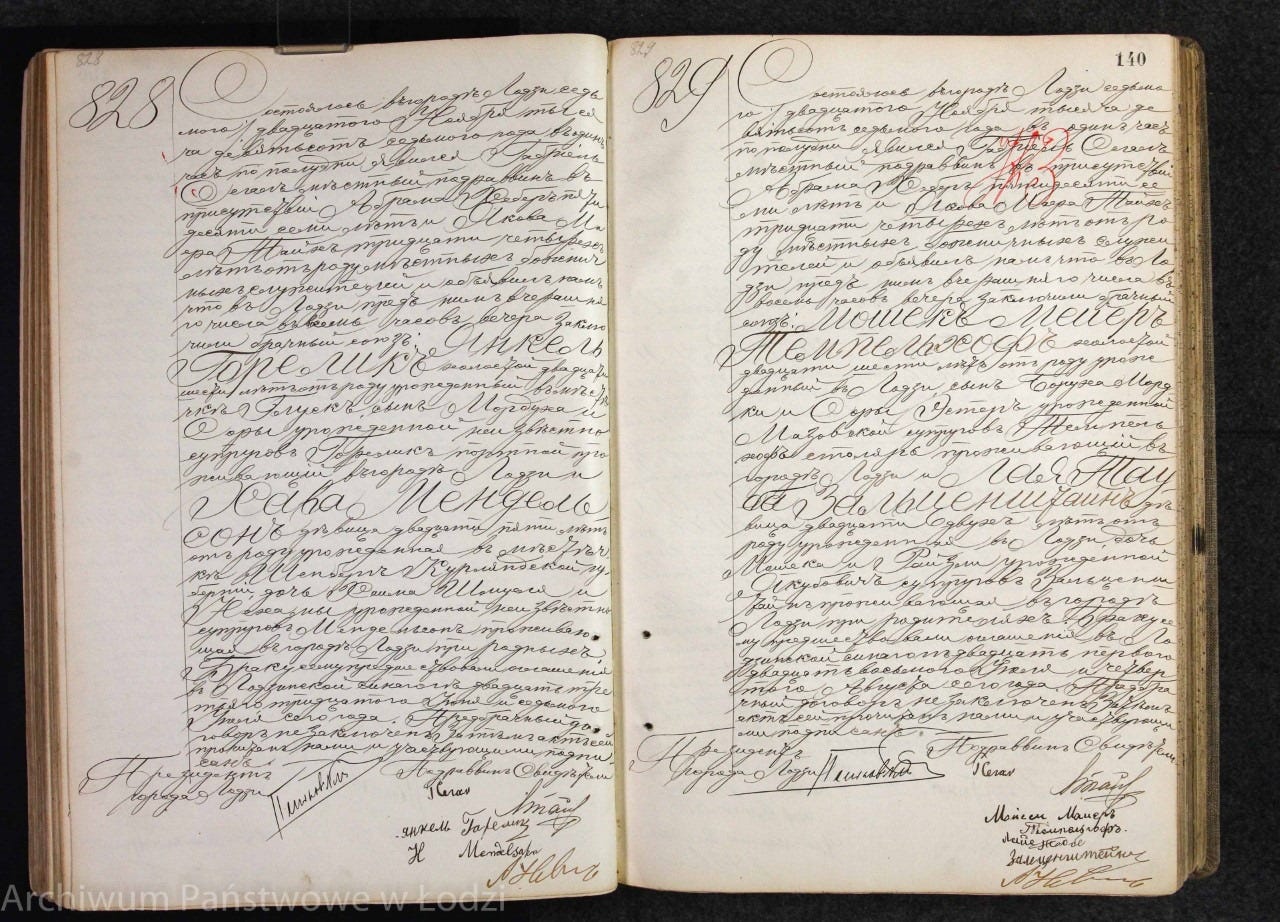
So in short succession, I was soon able to find Chava and Jacob’s marriage record from 1907, which confirmed without a doubt, via her parents’ names, that she was my grandfather’s cousin. I’m posting it just because it’s so beautiful.
Once I knew that this was the family, I easily found the birth records from Lodz of both of Chava’s children (Salcia was a nickname for Sarah) and learned that Chava had a third child as well, a son named Nathan, in 1924. I found Sarah/Salcia’s marriage record to Aron Kac, which confirmed that Lea Filitzer was indeed her sister-in-law. I found documentation that showed the family living in the Lodz ghetto during the war and learned that according to Lea Filitzer, Chava, Maks and Natan were murdered at Auschwitz in 1944; Sara died in the Warsaw Ghetto, circa 1942. (Max’s wife Mira Oderburg —and possibly Sara’s husband Aron, although it’s unclear—appears to have survived; there’s still more work to do.)
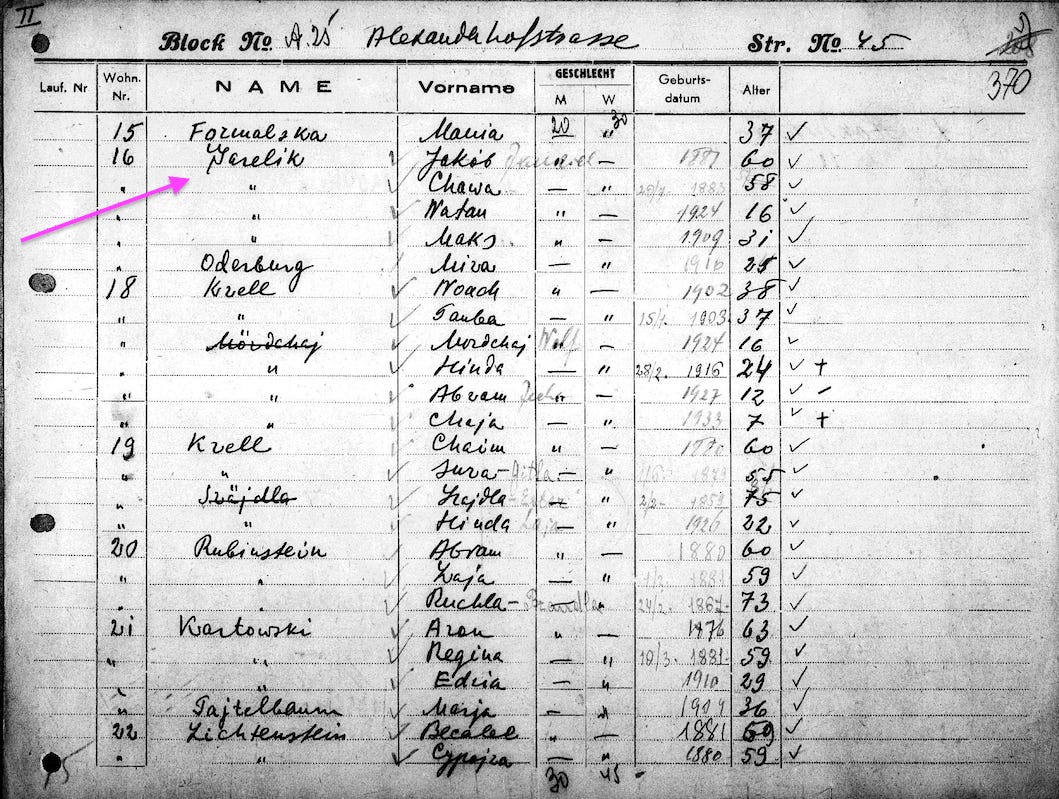
So.
Why do I spend time on this kind of research?
Because I feel reasonably confident that at this moment in time, I am likely the only person in the entire universe thinking about the Garelik family of Lodz, Poland, an unremarkable middle class Jewish family that disappeared off the planet 76 years ago with barely a trace. And knowing anything about them at all — that my second cousin once removed Sarah Garelik was born on August 28, 1908 at 9:00 in the morning, for instance, or that she was married to Aron Kac on the 28th of January in 1932 at 6 in the evening— restores just the teeniest bit of their stolen humanity and dignity.
It is my way of bearing witness. My solemn responsibility.
If I don’t do this work, who will?
*With gratitude to Michal Chemtob, Jody Tzucker, Maggie Paxson, Charles King, and Daniel Mendelsohn for translation assistance.
This brought tears to my eyes. What wonderful serendipity. I have been trying for years to find out the first name of my grandfather's sister in Dubno (now Ukraine), without success. I have one photo of her, but know nothing about her. Was she married? Did she have children? I, like you, am the only person in the world who thinks about her and wants to keep her memory alive. Maybe someday I'll find her, too. You give me hope!
People should be remembered. I have been using the Yad VaShem Latvian archive for my own search which has been very helpful. There is also the Latvian Jews FB group where people are very helpful.